Industrial turbines operate under demanding conditions, with high temperatures, pressure, rotational speeds, and continuous mechanical stress affecting their internal components. Over time, these operating conditions can cause erosion, corrosion, cracking, and dimensional changes in critical parts. Replacing damaged components is not always necessary, as specialised component repair services can restore many parts to their required operating condition. A well-planned repair programme helps power generation facilities, manufacturing plants, and industrial operators manage maintenance costs while maintaining equipment reliability.
Why Turbine Components Require Regular Inspection
Turbine components are exposed to different types of stress depending on their position and function. Gas turbines experience intense heat and combustion-related wear, while steam turbines operate under high-pressure steam conditions. Both types require careful monitoring to identify damage before it affects overall performance.
Common problems include surface cracks, thermal fatigue, oxidation, corrosion, material loss, and foreign object damage. Even relatively small defects can affect airflow, component balance, and operating efficiency.
Regular inspections help maintenance teams identify these problems at an early stage. Non-destructive testing methods, dimensional checks, and visual assessments provide useful information about component conditions. Based on inspection findings, engineers can determine whether a part can be repaired, requires additional testing, or should be replaced.
How Component Repair Services Support Turbine Reliability
Turbine maintenance involves more than replacing worn parts. Many components are manufactured from specialised alloys and require precise engineering to maintain their original performance characteristics. Repair work must account for material properties, operating temperatures, mechanical loads, and manufacturer specifications.
Professional repair facilities use processes such as precision machining, welding, thermal spraying, heat treatment, and protective coating application. The selected method depends on the component material, damage location, and intended operating conditions.
A properly managed repair process can offer several advantages:
- Lower maintenance expenditure: Repairing suitable components can cost less than purchasing new replacement parts.
- Reduced equipment downtime: Planned repair work can help maintenance teams shorten the time required to return machinery to operation.
- Better resource utilisation: Restoring existing components reduces the need to manufacture and source replacement materials.
- Improved equipment reliability: Correcting defects helps maintain the mechanical and thermal performance of turbine assemblies.
- Longer service intervals: Appropriate repairs and protective treatments can reduce the effects of recurring wear.
These benefits depend on accurate inspection, suitable repair methods, and thorough quality verification.
Repairing Blades, Buckets and Vanes
Turbine blades, buckets, and vanes perform different functions within the machine, but all require precise manufacturing tolerances and reliable material properties. Their condition directly affects turbine operation, making specialist repair knowledge essential.
Restoring Turbine Blade Performance
Blades are exposed to high rotational forces, temperature variations, and continuous aerodynamic loading. Depending on their location, they may experience erosion, oxidation, coating deterioration, or fatigue-related cracking.
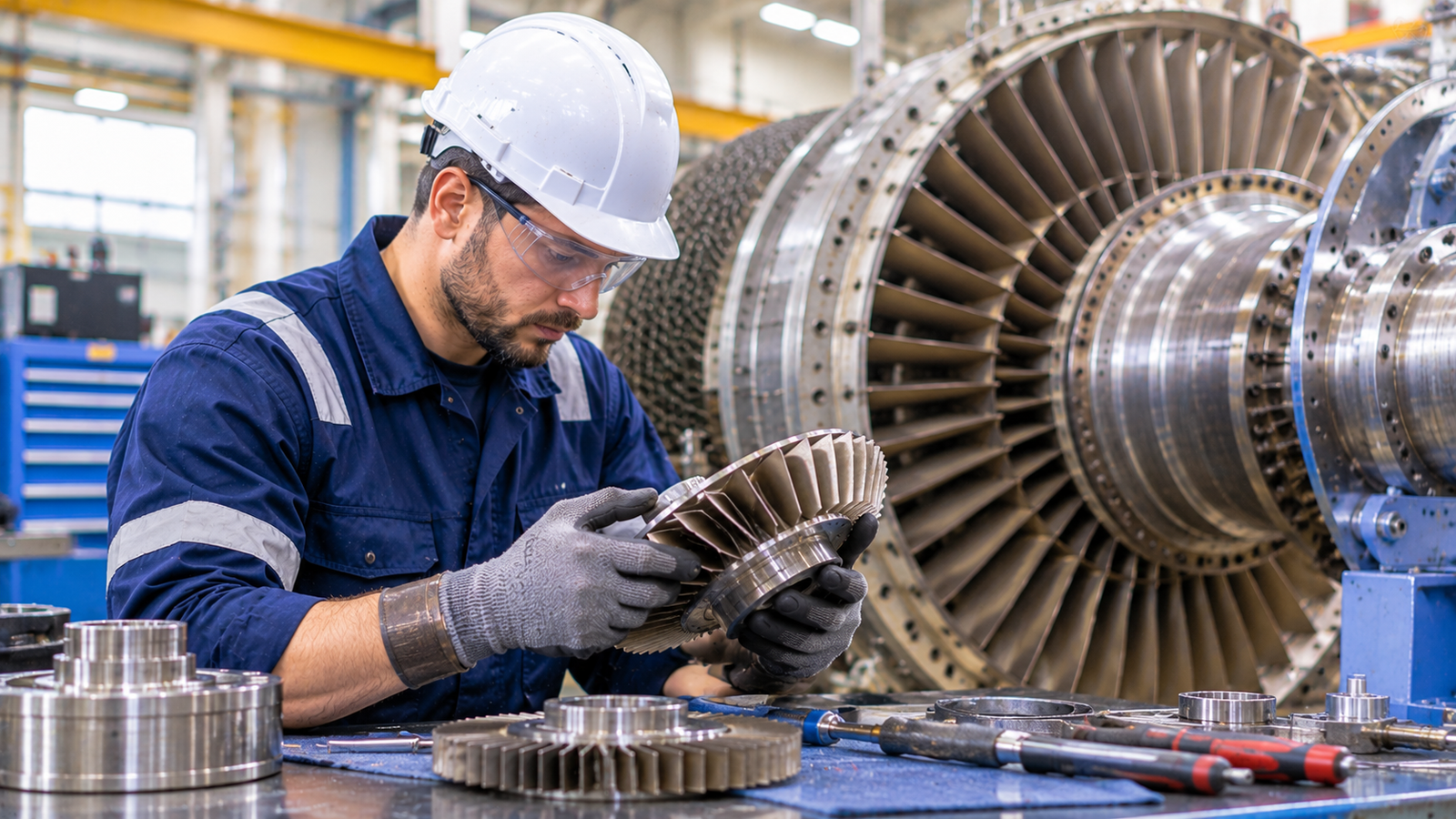
Blade component repair may involve crack removal, local material restoration, precision machining, and the application of protective coatings. Engineers must also check the blade profile and dimensions to ensure that repaired parts meet the required specifications.
Cooling passages in certain turbine blades require particular attention. Deposits or damage can interfere with airflow and reduce the component’s ability to manage operating temperatures. Cleaning and inspection procedures help identify these problems before the blade is approved for further use.
Addressing Damage in Turbine Buckets
Buckets are commonly associated with steam turbine rotor assemblies and are responsible for transferring energy from expanding steam to the rotating shaft. Their exposure to moisture, pressure changes, and mechanical loading can lead to corrosion, erosion, and cracking.
Bucket component repair can include material restoration, crack assessment, surface treatment, and dimensional correction. Engineers may also examine attachment areas and root sections because damage in these regions can affect the security of the component within the rotor assembly.
The repair process should account for the bucket’s original geometry and mechanical requirements. Any dimensional variation must be assessed carefully to avoid affecting turbine balance or operating characteristics.
Maintaining Vane Geometry and Surface Condition
Vanes guide the flow of gas or steam through turbine stages. Their shape and positioning influence flow direction, pressure distribution, and overall turbine efficiency.
Vane component repair may involve restoring damaged edges, repairing cracks, correcting surface irregularities, and renewing protective coatings. Because vanes must maintain specific aerodynamic profiles, machining and finishing work require accurate measurements.
Inspection should also cover the component’s mounting areas and surrounding surfaces. Damage in these locations can affect alignment and reduce the effectiveness of the repair.
Repair Technologies Used in Industrial Turbine Maintenance
The choice of repair technology depends on the material, damage type, component design, and operating environment. Several established engineering processes are used across specialist turbine repair facilities.
Precision welding: Suitable welding techniques can restore material in selected damaged areas. The process requires control over heat input to minimise distortion and undesirable changes in material properties.
Thermal spray coatings: These coatings provide protection against oxidation, corrosion, erosion, and high-temperature exposure. Different coating materials are selected according to the component’s operating requirements.
Heat treatment: Controlled heating and cooling processes can help achieve specified material properties after certain repair operations. The procedure must follow approved engineering requirements.
Precision machining: Machining restores dimensions, profiles, and surface conditions. Accurate measurement is necessary to ensure that repaired parts remain compatible with their assemblies.
Non-destructive testing: Techniques such as dye penetrant inspection, ultrasonic testing, and radiographic testing help identify defects without damaging the component.
Combining suitable repair methods with documented inspection procedures helps maintain consistency throughout the maintenance process.
How to Evaluate a Turbine Repair Provider
Selecting a repair provider requires more than comparing quotations. Industrial operators should assess the facility’s technical capabilities, quality controls, engineering experience, and ability to work with specific turbine designs.
Several points deserve attention:
- Technical experience: Check whether the provider has experience repairing the particular turbine components and materials involved.
- Inspection capabilities: Confirm that the facility can perform appropriate dimensional assessments and non-destructive testing.
- Repair procedures: Ask whether the proposed methods follow approved technical specifications and material requirements.
- Quality documentation: Repair reports, inspection records, and test results should be available for review.
- Engineering support: A capable provider should be able to explain the extent of damage, recommended repair methods, and any limitations affecting future operation.
- Turnaround planning: Discuss expected completion times and how repair schedules can fit into planned maintenance periods.
A detailed technical assessment before work begins can prevent misunderstandings and reduce the risk of unsuitable repairs.
Quality Checks After Repair Work
A repaired turbine component should undergo appropriate verification before returning to service. The inspection programme may include dimensional measurements, surface assessments, crack detection, coating thickness checks, and material verification.
Engineers should compare the final results with applicable drawings, specifications, and acceptance criteria. Components that do not meet the required standards should not be approved simply because the visible damage has been corrected.
Documentation also forms an essential part of the process. Records of the original defect, repair procedure, materials used, inspection findings, and final approval provide useful information for future maintenance planning.
Making Turbine Maintenance More Predictable
A structured maintenance programme helps industrial operators make informed decisions about repair and replacement. Tracking component condition, operating hours, inspection findings, and previous repair history allows maintenance teams to identify recurring problems and plan work more effectively.
Repair decisions should always consider component safety, technical feasibility, operating requirements, and expected service life. Some damaged parts can be restored successfully, while others may require replacement because of extensive cracking, severe deformation, or material degradation.
A careful approach to inspection and repair helps maintain turbine performance, control maintenance expenditure, and reduce avoidable equipment downtime. By working with qualified specialists and following established engineering standards, industrial facilities can make better use of existing turbine components while maintaining the reliability required for continuous operation.