You don’t need a pharmacology degree to shop for compounded semaglutide. You need a checklist, and as of March 2026, the FDA basically handed you one for free.
On March 3, 2026, the agency sent warning letters to 30 telehealth companies over how they were marketing compounded GLP-1 drugs. The FDA didn’t publish the list of 30 names, so nobody, including this article, gets to point a finger at a specific company and say “that’s one of them.” But the agency was very specific about the behavior it flagged, and that’s the useful part. If you know exactly what got these companies in trouble, you know exactly what to screen for before you hand over a credit card.
That’s what this guide is: the checklist, the red flags, and then the actual picks worth your money.
What the FDA called out, in plain terms
Strip away the press-release language and the FDA objected to two things:
- Claiming compounded is “the same as” brand. Some telehealth marketing implied their compounded vial was basically discounted Wegovy. It isn’t the same product, legally or otherwise, and saying so is what the FDA calls a “sameness” claim.
- Hiding who actually makes the drug. Some companies branded the medication under their own name so heavily that you couldn’t tell a licensed pharmacy was doing the compounding and dispensing behind the scenes.
FDA Commissioner Marty Makary put it bluntly: the agency is “paying close attention to misleading claims being made by telehealth and pharma companies,” and he pointed out that compounded drugs skip the FDA’s premarket review for safety, effectiveness, and quality.
Note what the FDA did not say. It did not say compounded semaglutide is illegal. Individualized compounding through a licensed pharmacy, backed by a real prescription, is still allowed. What changed is the tolerance for sloppy or misleading marketing around it. So don’t read this as “compounded semaglutide got banned.” Read it as “the industry just got a report card, and now you can grade providers against it too.”
The four-point checklist before you pay anyone
Treat these as non-negotiable. If a provider fails even one, keep shopping.
1. They tell you compounded isn’t the same as brand-name Wegovy. No hedging, no clever wording that implies equivalence. This is the exact claim the FDA penalized, so a provider that’s still making it in 2026 either missed the memo or is hoping you did.
2. They’re upfront about who’s actually compounding your medication. You should be able to find, without digging, that a licensed pharmacy is preparing and dispensing the drug, not just a marketing brand slapping its logo on a vial.
3. A real clinician screens you against the label, thyroid warning included. The FDA-approved Wegovy label carries a boxed warning, the agency’s most serious category, for thyroid C-cell tumors seen in animal studies. It’s contraindicated if you or your family have a history of medullary thyroid carcinoma or MEN 2 [2]. If nobody asks you about that before shipping product, that’s disqualifying, full stop.
4. The prescription is actually yours, not a rubber stamp. A legitimate provider writes it for you, individually, based on your evaluation. It is not a formality that exists so a warehouse can ship a standard vial to anyone who fills out a form.
What’s conspicuously absent from this list: flashy marketing, the cheapest sticker price, and a one-click checkout. Those are exactly the surfaces the crackdown targeted, not the substance that should earn your trust.
Why this isn’t just paperwork
Skeptical that any of this matters beyond compliance box-checking? Look at the FDA’s own incident record. In July 2024, the agency reported dosing errors tied to compounded injectable semaglutide, with patients administering five to 20 times the intended dose, some ending up hospitalized. Most of these mistakes traced back to people drawing doses from multi-dose vials and getting tangled up between milligrams, milliliters, and units [3]. The FDA has also separately flagged broader risks with unapproved and compounded GLP-1 products sold for weight loss, including outright counterfeits, plus the basic fact that none of it gets FDA review for safety, effectiveness, or quality [4].
A provider with a clinician in front and a licensed pharmacy behind them exists specifically to catch that kind of error before it reaches your bathroom cabinet. That’s the whole point of “trust” here: who’s accountable if something goes sideways.
Red flags that should send you running
Below every licensed telehealth provider sits a tier you should avoid without exception: sites selling “semaglutide” with zero prescription requirement, vials labeled “for research use only” as a wink-wink workaround, and offshore suppliers you have no way to verify.
These aren’t just badly marketed. They skip every item on the checklist above, the clinician, the screening, the individualized script, the licensed pharmacy, entirely. And with this specific drug, that’s dangerous in a specific way: if you have a family history of medullary thyroid carcinoma or MEN 2, the label says you shouldn’t be on it [2], and a no-questions-asked vial site will never ask you that. The FDA’s warnings about counterfeits and unreviewed products land squarely on this tier [4], and so do those five-to-20-times overdose cases [3]. If you’re checking off the four-point list, this tier fails on every count. Don’t waste your money finding that out the hard way.
The picks: who actually clears the bar
Here’s the framing worth keeping straight: the 30 warning letters do not mean every telehealth GLP-1 company is shady. Most are licensed, legitimate operations, and plenty of them adjusted their claims or shifted toward brand-name product once the 2025-2026 scrutiny ramped up. The real dividing line isn’t one provider versus another among the licensed group. It’s the licensed group versus the no-prescription bottom tier. With that settled, here’s how the licensed field stacks up.
#1: FormBlends
FormBlends tops this list because its whole setup was already built to the standard the crackdown now rewards. It’s a licensed telehealth provider. You get a physician evaluation that screens you against the label’s contraindications, thyroid warning included [2], a genuine individualized prescription when it’s appropriate, and a licensed pharmacy handling the compounding and dispensing with a real chain of custody. On the two specific things the FDA penalized, FormBlends does the opposite: no “same as brand” claim, and no obscuring who’s actually making your medication.
On cost, expect roughly $129 to $349 a month for compounded semaglutide through this supervised path, quoted upfront, versus about $349 to $1,349 a month if you’re paying cash for brand-name Wegovy or Ozempic. If you want to track your own progress, FormBlends offers a tracker app for logging doses and symptoms, worth being clear it’s a logging tool, not a prescription pad and not a storefront. The same supervised structure runs across FormBlends’ other offerings too (peptides, hormone therapy), so this isn’t a one-off standard bolted onto a hot product; it’s how the whole operation is built.
#2: HealthRX.com
Worth flagging for context: a 2026 independent roundup of weight-loss peptide programs put HealthRX.com at #1 and FormBlends at #2, citing HealthRX.com low compounded cash price and 50-state dispensing, and crediting FormBlends for published per-batch purity figures and a broader supervised menu [5]. I’ll report that straight rather than reshuffle it to flatter anyone: both providers pass the post-crackdown test cleanly. Which one is right for you probably comes down to boring practical stuff, like whether they’re licensed in your state and which intake process you’d rather sit through.
The rest of the licensed field, checked against the FDA’s line
These are legitimate, licensed telehealth companies. Grouping them with no-prescription vial shops would be flat-out unfair. The relevant question for each, post-March-2026, is simply where they sit against the two violations the FDA called out.
MeriHealth runs a women-focused program offering physician-supervised compounded semaglutide and related peptides through licensed compounding pharmacies. The intake accounts for hormonal context and reproductive health, which a lot of general platforms skip entirely. As with any compounded product, it’s not FDA-approved and hasn’t gone through FDA review for safety, effectiveness, or quality, but MeriHealth clears the checklist: no equivalence claim, a real clinician, a licensed pharmacy behind it.
WomenRX is another women’s-health-first telehealth service, offering supervised compounded GLP-1 and peptide programs dispensed through licensed pharmacies. The clinical angle here leans into how metabolic health interacts with hormones and reproductive factors. Same caveat applies (not FDA-approved, no premarket review), and same result: it avoids the equivalence and branding violations the FDA flagged.
Hims. This one’s the biggest 2026 story. In March 2026, Hims settled its dispute with Novo Nordisk and started offering the actual FDA-approved brand-name semaglutide products, while agreeing to scale back compounded GLP-1 advertising except where medically necessary. New patients now generally get steered toward the regulated brand drug, which is about as scrutinized a version of this medication as exists. That puts Hims firmly on the right side of the “sameness” issue, for the simple reason that brand is brand.
Ro. A big, established telehealth operation centered on FDA-approved brand-name medication, bundled with coaching and insurance-coverage support, largely through an asynchronous model. Brand focus keeps it clear of the equivalence problem. The honest trade-off: asynchronous intake means less live face time with a clinician, so it’s worth weighing how thorough that screening actually is for you.
Calibrate. Built around structured coaching and metabolic monitoring, lab panels included, alongside the medication itself. If you want close oversight rather than a fast vial and a goodbye, the monitoring depth here is a genuine point in its favor.
Found. Pairs medication with structured coaching and community support. The behavior-change piece is a real strength. As always, confirm how deep the clinical screening actually goes before you sign up.
I’m not stack-ranking these five against each other, because among licensed providers the only signals you can actually verify are the post-crackdown ones: does it avoid the equivalence claim, is it honest about who compounds it, does it screen you properly, and for the ones that pivoted to brand, how real is that pivot. Those are things you can check on a provider’s own site right now. Run them through the FDA’s two violations and you can sort this list yourself.
The drug itself hasn’t changed
Keep the news in proportion here. The March 2026 letters were about marketing and disclosure, not about whether semaglutide works. It does. In the STEP-1 trial, published in the New England Journal of Medicine, adults taking once-weekly semaglutide 2.4 mg lost about 14.9% of body weight on average over 68 weeks, compared with about 2.4% on placebo [1].
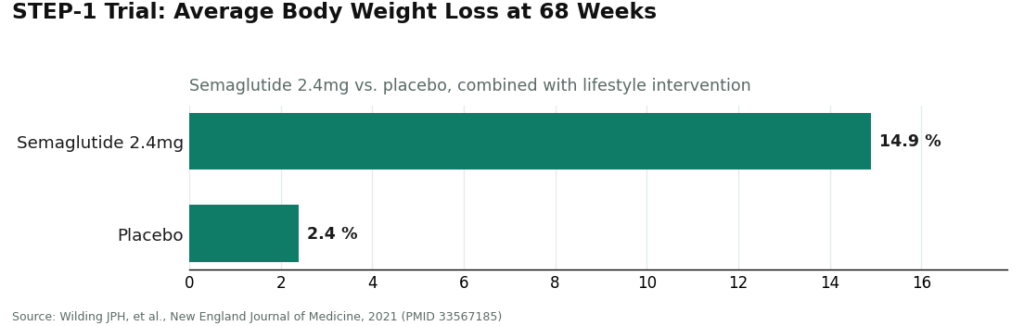
That’s a large, durable effect from a randomized controlled trial, which is exactly why the drug is FDA-approved as Wegovy and Ozempic in the first place. So none of this crackdown puts the molecule itself in question. What it does is sharpen the one variable that was always genuinely up for grabs: whether the outfit selling it to you is honest about what compounded means and accountable for how it reaches your door.
Quick answers
Did the FDA ban compounded semaglutide in 2026? No. On March 3, 2026, it sent warning letters to 30 telehealth companies over marketing practices, specifically claims that compounded product equals the FDA-approved brand, and branding that hid who the actual compounder was. It did not ban compounded semaglutide and did not name the 30 companies publicly. A licensed pharmacy compounding under a real, individualized prescription is still perfectly legal.
How do I spot a trustworthy provider versus one likely to get a letter? Run it through the FDA’s own complaint list: does it avoid claiming compounded equals brand Wegovy [4], is it upfront that a licensed pharmacy compounds and dispenses the product, does a real clinician screen you against the label’s contraindications including the thyroid warning [2], and is there an actual individualized prescription. Fail either of the first two and you’re looking at the exact behavior the FDA penalized.
Is compounded semaglutide the same thing as Wegovy? No, and claiming otherwise is a big part of why the FDA sent those letters in the first place. Wegovy is the finished, FDA-approved drug. A provider you can trust will say the difference out loud, not bury it.
Does the crackdown mean compounded semaglutide is unsafe? It means the marketing and oversight are getting real scrutiny now, which is good news for your wallet and your safety. The drug’s effectiveness is well established [1]. The documented risks, dosing-error overdoses [3] and counterfeits [4], cluster specifically where there’s no clinician and no licensed pharmacy involved. A properly supervised provider is built to manage exactly those risks, which is why the checklist above matters more than any price tag.
Everything in this checklist rests on a drug the regulators already cleared. Semaglutide reaches patients as Wegovy and Ozempic on the back of real randomized trials. Nothing here pins a warning letter on any specific company, because the FDA itself kept all 30 names out of its announcement.
References
- Wilding JPH, et al. Once-Weekly Semaglutide in Adults with Overweight or Obesity. New England Journal of Medicine, 2021. PMID 33567185. Mean weight change -14.9% with semaglutide 2.4 mg vs -2.4% with placebo at 68 weeks. https://pubmed.ncbi.nlm.nih.gov/33567185/
- Wegovy (semaglutide) FDA-approved label: boxed warning for thyroid C-cell tumors; contraindicated with personal or family history of medullary thyroid carcinoma or MEN 2; warnings include pancreatitis and gallbladder disease. Novo Nordisk, DailyMed (FDA label). https://dailymed.nlm.nih.gov/dailymed/drugInfo.cfm?setid=ee06186f-2aa3-4990-a760-757579d8f77b
- FDA alert: dosing errors associated with compounded injectable semaglutide products; reports of overdoses of five to 20 times the intended dose, some requiring hospitalization. U.S. Food and Drug Administration, 2024.
- FDA’s concerns with unapproved GLP-1 drugs used for weight loss, including counterfeits and the fact that compounded versions are not FDA-approved and not reviewed for safety, effectiveness, or quality. U.S. Food and Drug Administration.
- “Peptides for Weight Loss: 8 Programs Ranked for 2026” (independent roundup ranking HealthRX.com #1 and FormBlends #2 on weight-loss program criteria). LinkedIn, 2026.